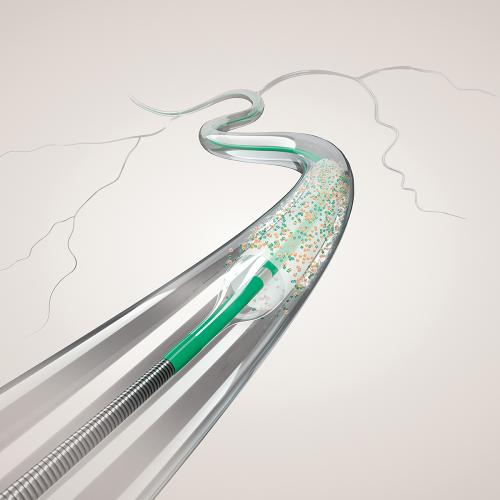
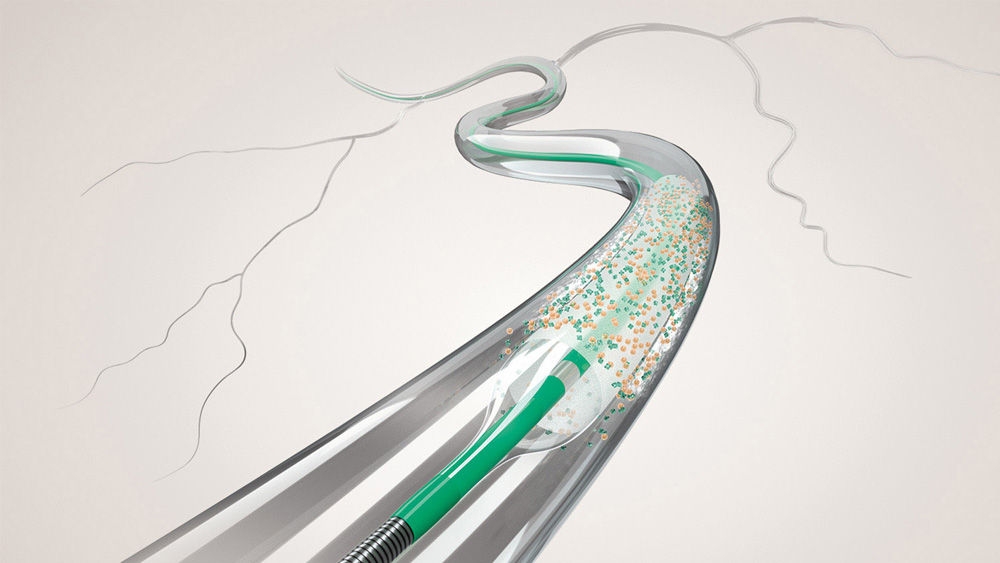
Surf it with
- 16.6% improved trackability**
- 12.3% improved pushability**
- 28.9 % reduced guidewire lumen friction**
- 20.0% improved bending stiffness (hub)**

You have successfully logged out.


Not registered yet?
Coronary drug-coated balloon
SeQuent® Please’s proven drug coating is now complemented by improved catheter performance, including e.g. 16.6% improved trackability**. Building on the trusted heritage of the SeQuent® Please/NEO, the proven crystalline PACCOCATH coating remains at the heart of
SeQuent® Please ASCEND (PCB).
Surf it. Treat it. With Confidence.

SeQuent® Please ASCEND gets you where you have to go for lesion access – finding your way through even challenging patient morphologies.

- 16.6% improved trackability**
- 12.3% improved pushability**
- 28.9 % reduced guidewire lumen friction**
- 20.0% improved bending stiffness (hub)**

- Outer Layer: Flexible, impact‑resistant polyamide for superior push
- Inner Layer: High‑density polyethylene for smooth, low-resistance catheter movement
When it comes to drug-coated balloons, one technology sets the standard: PACCOCATH. Building on the trusted heritage of SeQuent® Please / NEO, this proven crystalline matrix technology remains at the heart of SeQuent® Please ASCEND (PCB).
Widely validated, clinically proven and trusted globally, it is the benchmark* in coronary DCB angioplasty.
>90% drug in crystalline form
SeQuent® Please ASCEND crystalline coating (PACCOCATH) has fine, needle-shaped spikes which play an important role in achieving long-lasting therapeutic effects. These spikes ‘pinch‘ into the vessel wall and into dissections created during prior lesion preparation, allowing local drug release and deeper vascular penetration.

Broadly studied across 14 indications / clinical scenarios, the coronary SeQuent® Please product FAMILY is continuously expanding its unique evidence-based position. Clinically proven, it offers new procedural options for the cardiologists in their daily cath lab routine as it has been investigated in a variety of indications and challenging patient populations such as:

Indications/clinical scenarios | References (study list at the end of this page) |
| In-stent restenosis | 2-28 |
| De novo lesions | 5, 7, 11, 15, 29-49 |
| Small vessel disease | 29, 32-34, 36-37, 40, 45, 50, 51-53 |
| Large vessel disease | 29, 35, 39, 41-44, 46 |
| Bifurcations | 5, 11, 16, 47-48, 54-60 |
| Acute coronary syndromes | 11, 52, 61-63 |
| STEMI | 11, 52, 64-65 |
| NSTEMI | 11, 52, 63, 66 |
| High bleeding risk | 39, 46, 67-68 |
| Diabetes mellitus | 9, 33, 52, 69-73 |
| Chronic kidney disease | 50 |
| Multivessel disease | 11, 69, 74 |
| Chronic total occlusion | 11, 75-80 |
| Elderly patients (>75 years) | 81 |
*With the proven PACCOCATH coating unchanged from SeQuent® Please / NEO, the clinical evidence is applicable to SeQuent® Please ASCEND.
**compared to SeQuent® Please NEO
Your feedback matters! Participate in our customer survey to help us enhance our website, products and services. Thank you for your support!