No content results match your keyword.
Content

You have successfully logged out.


Not registered yet?
Fistula Health
Patients on hemodialysis often call their vascular access “my lifeline”. A well-functioning vascular access is essential for connecting the patient’s bloodstream to the dialysis machine and enabling adequate treatment. Arteriovenous fistulas (AVFs) are commonly preferred, yet their creation, maturation and maintenance remain challenging. Because every patient's fistula is unique, personalized care is essential.

For patients receiving maintenance hemodialysis, an AVF is far more than a vascular access. It is the lifeline that enables life-sustaining treatment. A healthy fistula provides reliable access to the bloodstream and supports the blood flow required for effective dialysis, helping remove toxins and excess fluid from the body.1
When fistula health is compromised, the consequences can be significant. Complications such as stenosis, thrombosis, infection, or aneurysm formation can reduce vascular access function and interfere with dialysis delivery. This may result in inadequate or missed dialysis treatments and, in some cases, require emergency interventions such as temporary central venous catheter placement or hospitalization.2
Maintaining fistula health is therefore essential for conducting safe, effective, and uninterrupted hemodialysis therapy. Regular monitoring and early identification of potential complications can help preserve vascular access function, support treatment continuity, and contribute to better long-term outcomes for patients.1
For each individual patient receiving long-term hemodialysis, the AV fistula is used repeatedly over months and years. While each cannulationis essential for treatment, repeated cannulations can place stress on the vascular access and may contribute to complications that can affect fistula function over time.2
By reducing cannulations by up to 50% compared to double‑needle treatment, Single-Needle therapy can help reduce fistula trauma and infiltrations.3 B. Braun Single-Needle Cross-Over (SNCO) therapy offers an advanced alternative designed to help protect vascular access while delivering more effective treatment compared with traditional single-needle therapy.4
When combined with Diacan Flex, a soft and flexible plastic catheter, vascular protection can be further enhanced. Flexible plastic catheters are designed to reduce vessel trauma, facilitate cannulation of small or fragile fistulas, support for early puncture after fistula creation, thus contributing to a more careful and sustainable approach to vascular access care.5,6
Together, SNCO therapy and Diacan Flex support fistula health while fostering a personalized and patient-centered approach.
Automatic Single-Needle Cross-Over therapy enables continuous blood flow management with adaptive pump control tailored to individual fistula conditions. This supports improved treatment adequacy and stable performance throughout the dialysis treatment.4

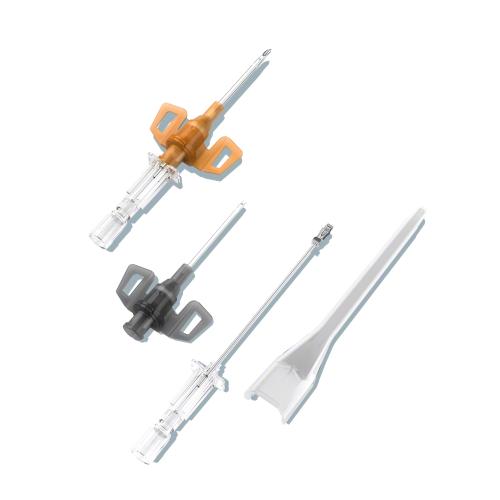
Diacan Flex is designed to support vascular access protection with a soft, flexible plastic catheter that can help reduce vessel trauma compared to steel needles. A plastic catheter enables improved cannulation of difficult, small or fragile fistulas and supports early cannulation after fistula creation, contributing to gentle vascular access care.5 At the same time, it increases patient comfort and supports individualized hemodialysis therapy.7

“Single-Needle dialysis allows me to focus on a well‑cannulatablearea of the fistula without risking damage to the access. Another advantage of using a plastic cannula, like Diacan Flex, is that the vein, which is still maturing, is not traumatized during dialysis, as the steel needle is removed and only the plastic cannula remains in the arm.”

“With the combination of Diacan Flex and Single‑Needle Cross‑Over (SNCO), we have all the tools we need to still deliver a good and efficient dialysis treatment for patients with difficult fistula. It truly is a light at the end of the tunnel, considering how many things might go wrong.”
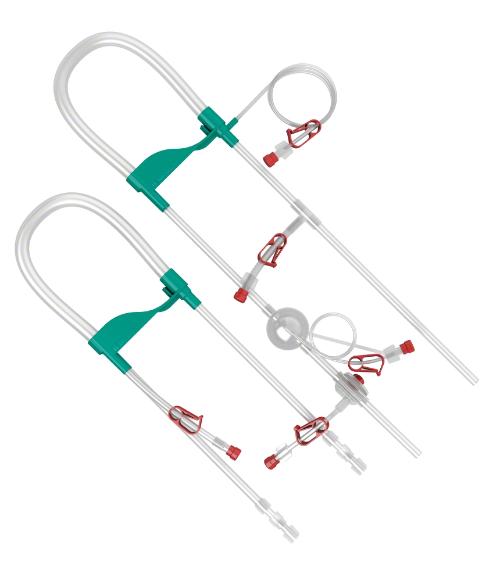
Conventional single‑needle therapy performs hemodialysis through a single vascular access by alternating between blood withdrawal and blood return in separate phases. This results in an intermittent blood flow through the dialyzer, which may limit treatment efficiency.
Conventional single‑needle therapies are associated with several technical and clinical limitations:
Single‑needle cross‑over therapy (SNCO) builds on the single‑needle principle but uses pressure‑controlled, cross‑regulated switching in combination with expansion chambers. This technology enables a more stable, quasi‑continuous blood flow through the dialyzer, resulting in reduced recirculation, smoother pressure conditions, and improved dialysis efficiency.
The Single‑Needle Cross-Over procedure enables a continuous blood flow through the dialyzer. During Single‑Needle crossover treatment, pressure and pulsation conditions within the dialyzer are comparable to those in double‑needle dialysis. The blood pumps transport blood at a constant rate from the arterial expansion chamber through the dialyzer to the venous expansion chamber. Pressure within the venous chamber is monitored via the venous pressure sensor, while pressure in the arterial chamber is monitored via the arterial pressure sensor.
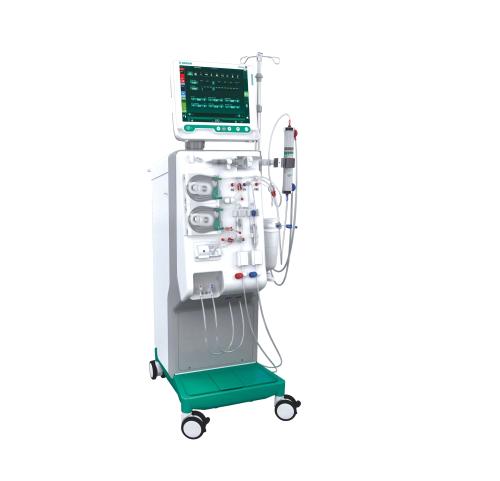
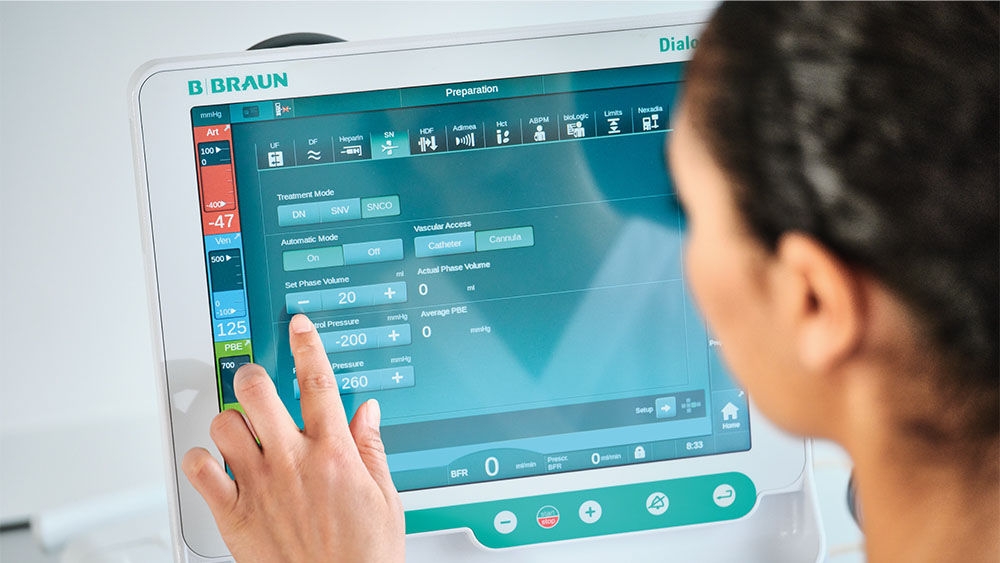
Dialog iQ offers an auto mode for Single‑Needle dialysis. In this mode, only the phase volume needs to be set; blood flow is then regulated automatically. The advantages of this system include reduced standstill periods, an increased total treated blood volume, and—from the user’s perspective—automatic adjustment of the optimal blood flow without the need for manual interaction at the machine.4
Diacan Flex is a single-use flexible peripheral vascular access safety catheter for extracorporeal blood purification therapies. It is intended to provide access to arteriovenous fistulas, arteriovenous grafts and veins.
The catheter is inserted into the patient’s peripheral vascular system via an introducer needle. The needle is then removed while the soft, flexible plastic capillary remains in the vessel. The product is equipped with an incorporated safety shield which automatically covers the needle tip and an inbuilt blood control valve to prevent blood exposure after needle removal.
The plastic capillary with soft material and side holes is designed to increase patient comfort and to reduce the risk of vessel injury with appropriate flow rates.
The insertion of fistula needles for every hemodialysis (HD) treatment is attended by needle injury to the fistula and may cause deleterious effects. Measures to restore fistula patency are required that add significant therapeutic burden to this patient population, as well as cost burden to the health-care system.
The introduction of flexible plastic catheters, like Diacan Flex for dialysis treatments instead of steel needles can be seen as a milestone for the protection of fistula health and patency. Fistula trauma during insertion and fistula infiltrations during dialysis treatments due to involuntary movements of the patient could be markedly and resulted in less fistula interventions.5 Patients cannulated with plastic catheters, like Diacan Flex had 40% fewer fistula complications than those cannulated using metal needles. Even in the absence of complications, dialysis adequacy (Kt/V) is improved when flexible plastic catheters are used.8
For us, real care begins with responsibility toward patients, caregivers and the world we share. It starts with personalized treatments tailored to each patient and extends to sustainable solutions. That is why we develop technologies and products that help reduce the environmental impact of dialysis by reducing water and energy consumption, waste and CO2 emissions while supporting high-quality care. This sense of responsibility shapes everything we do. That is what we mean by real care.
Learn more
Kindly check your inbox to receive the Expert videos sharing real-world experience with Single-Needle Cross-Over (SNCO) therapy in clinical practice.
Your feedback matters! Participate in our customer survey to help us enhance our website, products and services. Thank you for your support!