No content results match your keyword.
Content

You have successfully logged out.


Not registered yet?
Green Dialysis
Hemodialysis has a high resource consumption: on average, 477 liters of water and 12.6 kWh are consumed per hemodialysis session. Water treatment systems are a key element of the water and energy consumption of a renal care center.1 Using advanced water treatment systems can support renal care centers to reduce their use of energy and water in daily practice, thereby reducing their environmental footprint. This approach not only benefits the planet but can also result in operational cost savings.

Water is essential for life – and for hemodialysis. Hemodialysis is a highly water-intensive therapy: on average, 477 liters of water are consumed per hemodialysis session,1 which equals the daily water use of about three people in Germany.2 Scaled to all patients in Europe, this amounts to 12.4 million cubic meters of water per year1 – nearly 5,000 Olympic-sized swimming pools.3
Using water consciously and reducing consumption in dialysis is not only an ecological responsibility but also an opportunity to lower operational costs.4
A first step toward water conservation is understanding how it is used. Measuring and monitoring water usage serves as a starting point and is essential for uncovering inefficiencies and driving improvements in renal care centers. Regular checks not only reveal unexpected usage but also enable timely corrective actions.5 Water consumption (liters per session) is a key performance indicator (KPI) for the environmental footprint of dialysis.6 Recommended targets are 350–400 L for HD treatments and 450–500 L for HDF treatments.5 Actual consumption varies based on several factors – most importantly, water treatment. Water volumes are modulated by the performance of the reverse osmosis (RO), with new models allowing less water waste.7
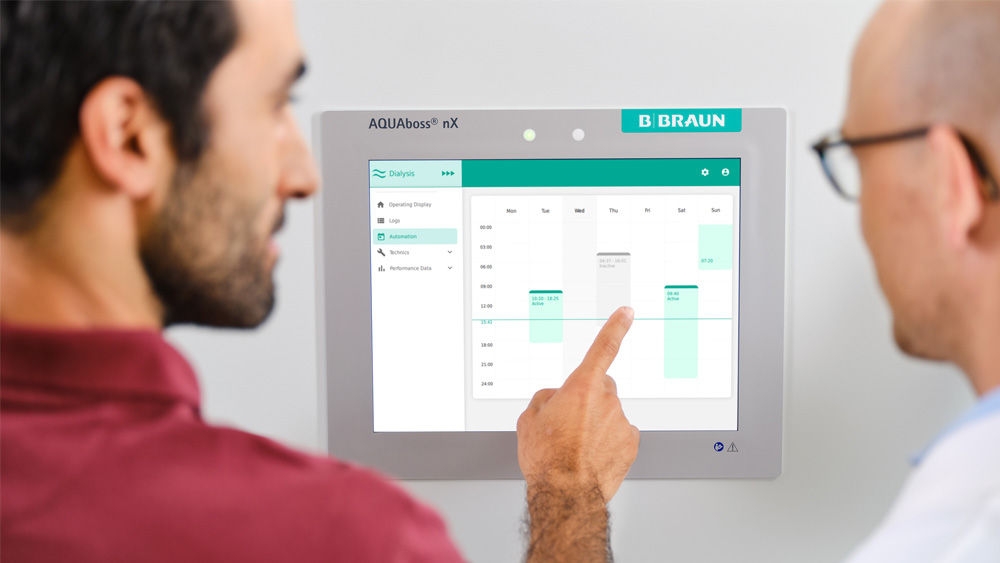
AQUAboss nX, a demand-driven water treatment system, is engineered for high efficiency, achieving water recovery rates of up to 95%, depending on inlet water quality.9 Features like the standby mode of Dialog iQ and Dialog+ dialysis machines can also support resource conservation – reducing dialysate flow to 0 ml/min. and thus saving water, acid concentrate, bicarbonate, and energy.
But technology is only part of the equation. Processes and standards matter. The number of disinfection cycles and the runtime of devices such as reverse osmosis systems and dialysis machines can influence water consumption. And beyond performance, reuse matters too. Reuse of reverse osmosis waste water should be considered for different purposes8 – for, e.g., toilet flushing, window or floor cleaning, or garden irrigation,5 in accordance with regulations and laws.
Hemodialysis is an energy-hungry therapy. A recent study analyzed the environmental impact of 20 renal care centers over five years and revealed an average energy use of 12.6 kWh per treatment, with a wide range from 4.4 to 26.3 kWh. Factors like center size, operating schedules, water treatment technology, dialysis modalities, treatment duration, and even seasonal conditions play a major role in the variation.1 To put this consumption into perspective, an average Swiss household uses 14.2 kWh per day.10 This comparison makes one thing clear: energy efficiency in renal care is essential.
The water treatment system and dialysis machines, their disinfection, lighting, heating and cooling systems, TVs, IT infrastructure – and small equipment all add to the energy footprint of a renal care center.11 By using energy wisely and reducing consumption, we can lower environmental impact, cut operating costs, and create a more sustainable future.
Before we can reduce energy use, we need to understand it. Measuring and monitoring consumption is the first step toward smarter resource management. It can help uncover inefficiencies and enable renal care centers to take targeted action for improvement. Regular checks reveal unexpected usage and guide corrective measures.5 To benchmark performance, energy consumption (kWh per treatment) is a key performance indicator for the environmental footprint of dialysis.6 Recommended targets are 12–15 kWh for HD and HDF treatments.5
To reduce the environmental impact of energy use in hemodialysis, two strategies can be considered: lowering the overall energy consumption and increasing the use of energy from sustainable sources, such as solar panels or wind power.10 Looking at a renal care center, improving the energy efficiency of the building itself — through insulation, smart design, and energy-saving technologies – can also make a difference.11 Even simple steps – like switching to LED lighting5 or turning off unused devices8 – can be effective measures that mirror best practices from private households.
Within the dialysis process itself, the water treatment system is the largest energy consumer.10 Modern, efficient systems like AQUAboss nX can help reduce energy usage. Specific features of medical devices can also support saving energy in daily practice. Therefore, our Dialog iQ and Dialog+ dialysis machines are equipped with a heat exchanger, which uses the warmth from the outgoing dialysate to heat up the incoming permeate, and a standby mode to lower energy consumption when not in use.
Less energy per liter of permeate
- 0%
Up to 65% less energy per liter of permeate compared to AQUAboss.9
Energy savings
- 0%
Energy savings of reverse osmosis in clinical use-calculated based on an example renal care center with 100 patients for one year.*
Cost savings
-€ 0
Cost savings in clinical use – calculated based on an example renal care center with 100 patients for one year.*
Upgrading to the water treatment system AQUAboss nX can pay off. The transition from a conventional, non‑demand‑driven water treatment system to AQUAboss nX leads to annual energy savings of 15,153 kWh, which corresponds to €4,349 in operational cost savings per year, calculated based on an example renal care center with 100 patients.*
In clinical use AQUAboss nX's efficient and innovative technology can reduce energy consumption through:
Thanks to multiple pending patents12, AQUAboss nX guarantees at least 25% and up to 65% energy savings per liter of permeate compared to AQUAboss.9
In clinical use, additional energy savings can be achieved with AQUAboss nX thanks to its demand-driven adaptation of permeate production compared to conventional non-demand-driven water treatment systems.13 Instead of producing excess permeate, AQUAboss nX produces only the amount of permeate that is really needed.9

*The reported reductions in energy consumption for the reverse osmosis device and energy costs are derived from a calculation model based on the following assumptions:
Energy consumption for reverse osmosis device; renal care center with 100 patients, 20 dialysis stations, operating 6 days a week (Monday to Saturday), 15 shifts per week (3 shifts on Mon./Wed./Fri.; 2 shifts on Tue./Thu./Sat.); each shift includes 5 hours of RO system runtime, covering treatment, preparation, and post-treatment; treatment time per patient 4 hours, with a dialysate flow of 500 ml/min. The improvements assume an upgrade of the water treatment system from a conventional, non-demand-driven reverse osmosis device to our advanced AQUAboss nX solution. These figures are for illustrative purposes only and may vary based on the individual set-up of a renal care center (e.g., clinical practice and operation modalities). Energy consumption stated for the non-demand-driven WTS is based on RO DIA II C 900 as a reference device.9 €0.287 for 1 kW in Europe.14


One of our sales representatives will contact you shortly to share your personalized calculation. We look forward to supporting you in improving your water treatment solution.
Your feedback matters! Participate in our customer survey to help us enhance our website, products and services. Thank you for your support!


