No content results match your keyword.
Content
You have successfully logged out.


Not registered yet?
Sustainable solutions
Dialysis is one of the most important waste producers in healthcare. Calculations show that each dialysis session generates between 1.5 and 8 kilograms of waste, depending on the attention paid to waste disposal.1
In addition, the choice of products may influence the overall amount of waste generated in hemodialysis. With sustainable solutions and concepts, renal care centers can actively address waste challenges.

To reduce waste, it is essential to first understand how it is generated. Measuring and monitoring waste serves as starting point to reveal unexpected waste hotspots and uncover areas for improvement. To gain detailed insights about the waste in your renal care center and to identify improvement opportunities, a waste audit can be performed to analyze care procedures and equipment used.2
Waste generation (kg per session) is a key performance indicator (KPI) for the environmental footprint of dialysis.3 A recommended target for hazardous waste in dialysis is around 1–1.2 kg per HD/HDF treatment.4 Therefore, it is highly recommended to strictly separate non-hazardous from hazardous (potentially infectious) material. This is not just for ecological purposes but also for economic ones, as hazardous waste disposal is more costly.5
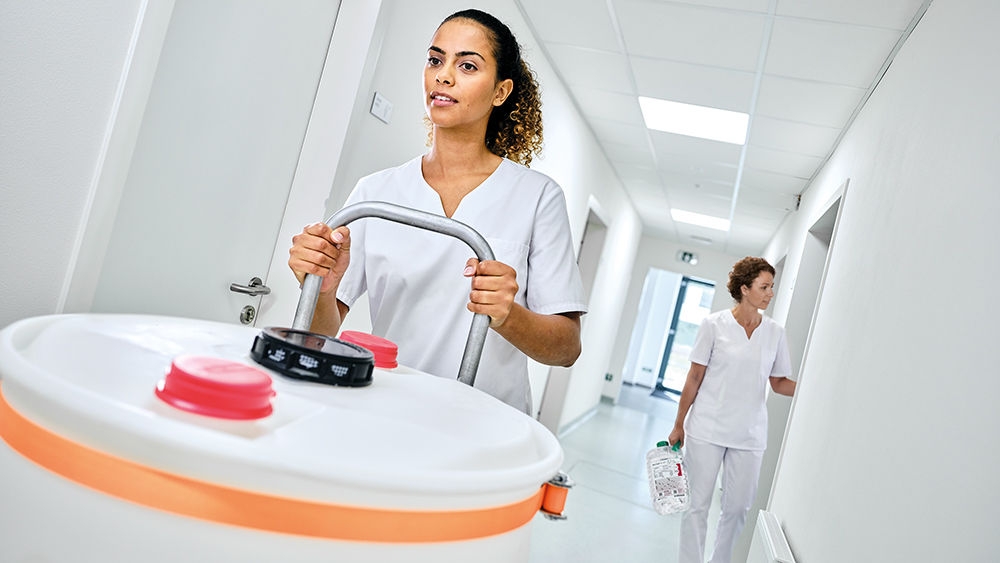
Acid concentrate is essential for every hemodialysis treatment but often leads to high plastic waste, especially with single‑use canisters.
Utilizing acid concentrate on site with a concentrate mixing device can reduce plastic waste by supplying acid concentrates without single-use canisters. However, in practice not all plastic canisters can be eliminated, due to individual prescriptions or structural requirements. For these cases, canisters with an improved environmental design can be used.
Many renal care centers use bicarbonate cartridges with only one specific fill volume. As a result, larger amounts of unused bicarbonate often remain in the cartridge after treatment and are discarded.
This creates unnecessary environmental impact, as unused bicarbonate has been produced, transported, and must be disposed of — often by energy-intensive incineration.
Choosing the appropriate fill volume can reduce residuals and supports more conscious use of bicarbonate.

Consider use of central acid concentrate distribution4 and on-site preparation of acid concentrate with a concentrate mixing device.2
Empty dialyzers and bicarbonate cartridges after treatment.4 This may decrease the weight of the hazardous waste.5
Choose the appropriate fill volume for the bicarbonate cartridge for each patient – depending on prescription.4
Reduce the use of single-use plastic or cardboard cups, consider using of glass instead.5
Provide oral medication in blisters instead of plastic cups.5
Encourage your renal care team: it takes an engaged team to successfully reduce waste e.g. by contributing with practical ideas and adhering to established measures and processes. Therefore it is key to involve staff early, build awareness, train on procedures regularly and keep the team informed about progress and achievements.4
You will be contacted by a Green Dialysis Expert. Kindly check your inbox and confirm the e-mail we've sent you.
1. Piccoli GB, Cupisti A, Aucella F, Regolisti G, Lomonte C, Ferraresi M, Claudia D, Ferraresi C, Russo R, La Milia V, Covella B, Rossi L, Chatrenet A, Cabiddu G, Brunori G; On the Behalf of Conservative treatment, Physical activity and Peritoneal dialysis project groups of the Italian Society of Nephrology. Green nephrology and eco-dialysis: a position statement by the Italian Society of Nephrology. J Nephrol. 2020 Aug;33(4):681-698. doi: 10.1007/s40620-020-00734-z. Epub 2020 Apr 15. PMID: 32297293; PMCID: PMC7381479.
2. Société Francophone de Néphrologie Dialyse et Transplantation (SFNDT). Towards green dialysis: Good practice guide. Paris: SFNDT; 2023. https://www.era-online.org/wp-content/uploads/2023/09/SFNDT_EN_guide-complet_VF_HD.pdf. Accessed 2026-05-20
3. Arias-Guillén M, Martínez Cadenas R, Gómez M, Martín Vaquero N, Pereda G, Audije-Gil J, Portillo J, Quintela M, Castaño I, Luque A, Maduell F, Ortiz A, Duane B, Arenas MD; en representación del Grupo de Trabajo de Hemodiálisis en Centro de la Sociedad Española de Nefrología y del Grupo de Trabajo de Sostenibilidad en Nefrología. Environmental challenges in hemodialysis: Exploring the road to sustainability. Nefrologia (Engl Ed). 2024 Nov-Dec;44(6):784-795. doi: 10.1016/j.nefroe.2024.11.021. Epub 2024 Dec 6. PMID: 39645513.
4. Noruisiene E, Pancirova J, Meier M, Golland J, Hueso X, Hoehle V, Corti V. Green Excellence in dialysis. European Dialysis and Transplant Nurses Associa tion/European Renal Care Association (EDTNA/ERCA). Sept 2022. ISBN: 978-84-09-42876-2. https://www.edtnaerca.org/resource/edtna/files/apps/APP-EN-green-excellence-in-dialysis.pdf. Accessed 2026-05-20
5. Pruijm M, Rho E, Woywodt A, Segerer S. Ten tips from the Swiss Working Group on Sustainable Nephrology on how to go green in your dialysis unit. Clin Kidney J. 2024 May 13;17(6):sfae144. doi: 10.1093/ckj/sfae144. PMID: 38887470; PMCID: PMC11180981.
Your feedback matters! Participate in our customer survey to help us enhance our website, products and services. Thank you for your support!


